Quick answer: An AI receptionist for small business answers calls, understands what the caller needs, books or routes the job and logs everything in your systems. If you only need call answering, FAQs and simple booking, a SaaS AI receptionist is usually enough. Build a custom AI phone agent when calls must read and write to your own CRM, scheduling or job data, follow strict compliance rules, or handle workflows no off-the-shelf tool supports.
Interest is rising fast. Google Keyword Planner (United States, last 12 months) shows about 3,600 monthly searches for "ai receptionist for small business", about 2,400 for "ai phone agent", about 1,600 for "ai customer service agent" and about 33,100 for "ai voice agent", with year-over-year growth of several hundred to several thousand percent on the receptionist and voice-agent terms. This guide explains how these systems work, when to buy and when to build, and how to run a pilot without betting the front desk on it.
What an AI receptionist actually does
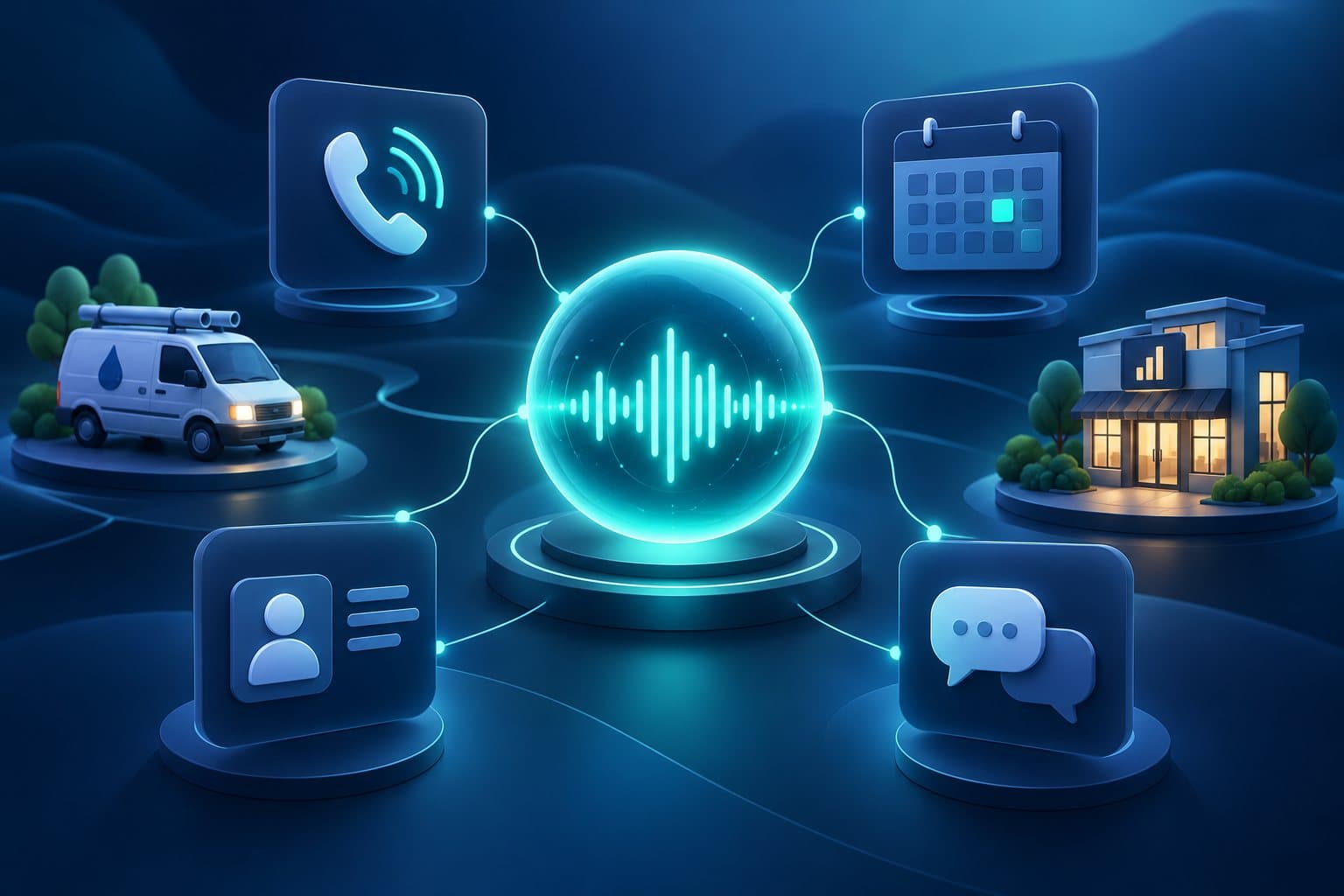
An AI receptionist is a voice agent that picks up the phone, holds a natural conversation and completes a defined set of front-desk tasks. For a plumbing company that might mean qualifying an emergency, collecting the address and booking a time window. For an accounting firm it might mean answering "what documents do I need?", booking a consultation and routing existing clients to the right person.
- Answer every call, including after hours and during peak periods.
- Answer common questions from approved content (hours, services, service area, starting prices).
- Capture structured details: name, phone, address, job type, urgency.
- Book, reschedule or cancel appointments in your calendar or scheduling tool.
- Transfer to a human or send an urgent alert when rules say so.
- Write a summary to your CRM or job system after the call.
How an AI phone agent works: the technical stack
Every AI phone agent is a pipeline of five components, and the quality of the experience depends on how well they are connected and how fast they respond. Latency is the main difference between a call that feels natural and one that feels robotic.
- Telephony: a phone number and call handling (SIP or a cloud telephony provider) that streams audio to the agent and can transfer calls.
- Speech-to-text (STT): converts the caller's speech into text in real time, including names, addresses and numbers.
- Language model and agent logic: decides what to say and which action to take, constrained by your instructions, approved knowledge and business rules.
- Tools and integrations: calendar, CRM, job management or practice software, accessed through APIs or a protocol such as MCP (see MCP explained).
- Text-to-speech (TTS): turns the response into a natural voice and handles interruptions when the caller talks over the agent.
Around this pipeline you need logging, call recordings or transcripts (with consent), evaluation of conversation quality and a clear fallback path to a human.
Buy a SaaS AI receptionist or build a custom voice agent?
Buy when your needs match the product's standard workflow; build when the call has to work with your own systems and rules. Many businesses start with SaaS and move to custom only after they hit integration or control limits. Our detailed comparison in Build vs Buy AI Agents in 2026 covers the general trade-offs; here is how it applies to the phone.
A SaaS AI receptionist is usually enough when
- Calls are mostly FAQs, message taking and simple appointment booking.
- Your calendar or CRM is one the vendor already integrates with.
- You are comfortable with the vendor storing recordings and transcripts under its terms.
- You need to go live in days and can accept the vendor's conversation design.
A custom AI phone agent makes sense when
- The agent must read and write live data: job status, technician availability, quotes, invoices or client files.
- You run several locations, brands or languages with different rules.
- Compliance requires control over where audio and transcripts are stored and who can access them.
- You want the same agent logic on phone, website chat and messaging, sharing one knowledge base.
- Per-minute pricing at your call volume becomes more expensive than owning the workflow.
Examples: plumbing companies and accounting firms
The same technology solves different problems depending on the business, so define the job of the agent before choosing a tool.
Plumbing and home services
The value is answering emergency calls that would otherwise go to voicemail. A useful agent triages urgency (active leak versus routine repair), collects the service address, checks whether the address is inside your service area, offers a time window and alerts the on-call technician for true emergencies. It should never promise an arrival time or a final price that the business has not approved.
Accounting and tax firms
The value is handling seasonal peaks without hiring temporary staff. A useful agent answers document checklist questions, books consultations by service type, confirms deadlines from approved content and routes existing clients. It must not give tax advice, and it should never ask callers to read out full identification or account numbers.
Security, privacy and compliance for AI voice agents
Treat a voice agent as a system that handles personal data in real time: plan consent, data minimization and access control from day one. Our AI Agent Security Checklist lists 12 controls that apply here.
- Call recording consent: federal law and most US states allow one-party consent, but California and several other states require all parties to consent. Announce recording and AI use at the start of each call.
- Outbound calls: in February 2024 the FCC confirmed (FCC 24-17) that the TCPA's rules on "artificial or prerecorded voice" cover AI-generated voices, so outbound AI calls require the called party's prior express consent. Keep the receptionist inbound-only unless you have that consent.
- PII and payment data: collect only what the task needs, mask sensitive fields in transcripts and never take card numbers through the voice agent unless the payment flow is designed for it.
- Prompt injection and tool safety: callers can try to talk the agent into actions. Limit what each tool can do and require confirmation for changes.
- Vendor terms: check whether your provider uses call data to train models and where it stores recordings.
This is general information, not legal advice; confirm requirements for your states and industry with counsel.
What drives the cost of a custom AI receptionist
The cost of a custom voice agent depends mainly on integrations, conversation complexity and call volume, not on the AI model alone. We avoid quoting generic numbers here because they vary widely; our AI Agent Development Cost in 2026 guide breaks down build and running costs in detail.
- Number and quality of the systems the agent must integrate with (calendar, CRM, job management, practice software).
- Number of call flows, languages and locations.
- Usage-based costs for telephony, speech-to-text, the language model and text-to-speech, which scale with minutes.
- Evaluation, monitoring and human review time after launch.
- Security and compliance requirements such as data residency and retention.
A 30-day pilot plan
Start narrow: one phone line, a few call types and a human fallback, then expand only when the numbers prove it works. The full method is in our AI Agent Implementation Roadmap 2026.
- Week 1: listen to recent calls, list the top call reasons and decide which ones the agent handles and which go to a human.
- Week 2: write approved answers, connect the calendar or CRM in a test environment and define escalation rules.
- Week 3: run the agent after hours or on overflow only. Review every transcript daily.
- Week 4: measure answered calls, bookings, transfers and complaints, then decide whether to expand, adjust or stop.
For production architecture, monitoring and evaluation, see How to Build Production-Ready AI Agents.
How Nextchain can help
Nextchain builds custom AI agents and integrations for businesses that have outgrown off-the-shelf tools. Our own product, 24hagent.chat, lets businesses create a personalized AI assistant from their documents, and we apply the same document-grounded approach to voice and chat agents for clients. If you are comparing SaaS AI receptionists with a custom build, we can review your call types, systems and compliance needs and recommend the simpler option when it is enough.
Frequently asked questions
Can an AI receptionist replace my front desk staff?
It can take routine calls, after-hours calls and overflow, but most businesses keep a human for complex, sensitive or upset callers. Design a clear transfer path from day one.
Will callers know they are talking to AI?
They should. Disclose AI and recording at the start of the call; it builds trust and supports consent requirements in all-party consent states.
How long does it take to launch a custom AI phone agent?
A narrow pilot with one or two integrations can run within a month using the plan above. Broader rollouts depend on the number of systems and call flows.
Can the same agent work on my website chat?
Yes. A custom build can share one knowledge base and set of tools across phone, web chat and messaging, so answers stay consistent.